


Find out why...
Air conditioning is no longer an exclusive luxury found only in high-end vehicles. Today, even the most basic versions of almost any model include it as standard, and it has become as everyday an element as the engine or the brakes. Precisely for that reason, when it stops cooling as it should, you notice immediately.
Before reviewing the most common failures, it is worth understanding — in simple terms — how this system works.
How does a car's air conditioning work?
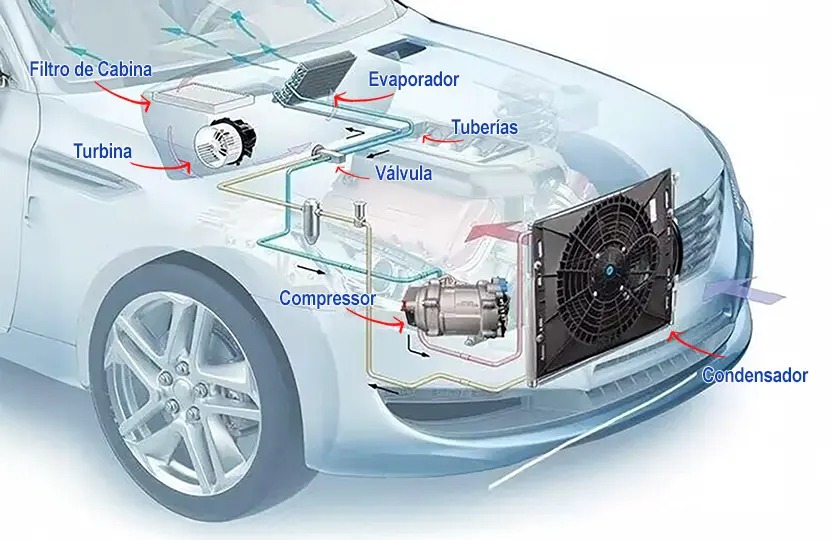
The principle is the same as that of a household refrigerator: a compressor compresses a refrigerant gas and then allows it to expand, returning to its gaseous state. During that decompression process, the gas absorbs heat from the surroundings, generating temperatures that can drop below 0 °C. A fan distributes that cold air into the interior of the cabin through the vents.
With that clear foundation, let's look at the five most common reasons why the system stops cooling properly.
1. Saturated air conditioning filter
Also known as the cabin filter, dust filter, or pollen filter, it is one of the first suspects when the air comes out weak or not as cold as it should be. When it becomes saturated with dust and impurities from the environment, it restricts the airflow to the vents.
It is recommended to replace it approximately every 20,000 km. If you also notice a bad smell when the system is turned on, a deep chemical cleaning is likely needed to eliminate bacteria that have accumulated in the evaporator.
Why is this filter so important? Because without it, outside air — carrying dust, dirt, and other particles — would flow directly into the cabin. Over time, that dirt would accumulate inside the car and be breathed in by the occupants, with the resulting health risks.
2. Broken or loose accessory belt
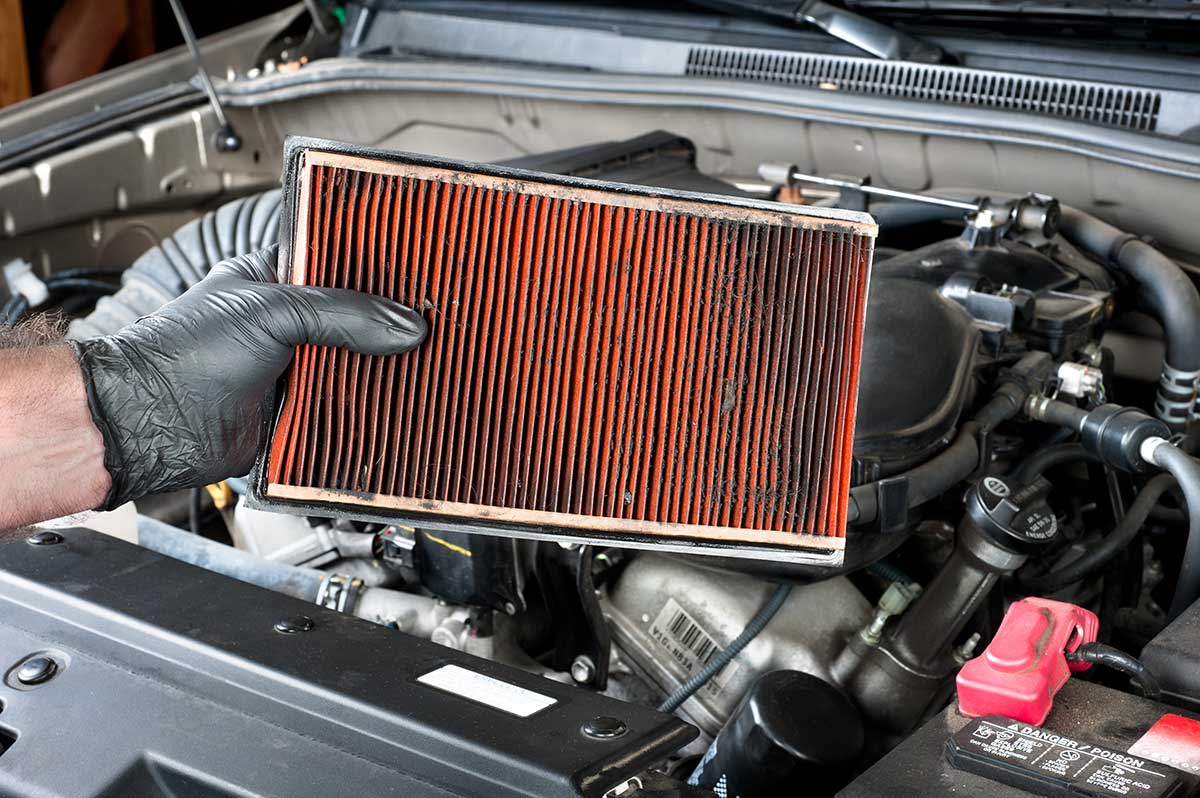
The accessory belt is one of the key components that gets the system running. Depending on the car model, it may be a belt dedicated exclusively to the air conditioning or a shared belt that drives several engine components.
When the air conditioning is activated, the compressor pulley (or "clutch") engages to compress the refrigerant gas. If the belt is broken, worn, or simply lacks the proper tension, the system will not be able to function. For that reason, before checking any other component, it is worth doing a quick visual inspection of the belt to confirm it is in good condition.
3. Lack or excess of refrigerant gas
Over time, the gas circulating through the system deteriorates and loses its properties. The air conditioning is a very sensitive system in terms of its operation, so even a minimal lack of gas can noticeably affect its performance.
Each manufacturer specifies the exact amount of gas (in liters or kilograms) the system should contain, information that is normally found on a label inside the engine compartment.
The opposite problem can also occur: an overcharge of gas. This usually happens after a repair or the replacement of a component, since the system must be completely emptied and recharged with the exact amount specified by the manufacturer. If more gas than recommended is added, the system can become overcharged and damage the compressor or a pressure valve. In more recent models, this excess can even activate a protection mode that simply shuts down the cooling.
4. Hoses or condenser damaged by a collision
Even a minor frontal impact can crack or damage parts of the air conditioning system without it being obvious to the naked eye. The hoses through which the gas circulates are rigid, so they crack relatively easily upon impact. Added to this is the fact that the condenser is typically located at the front of the vehicle, next to the radiator — an area that is especially exposed in any collision.
If the crack is small, you may not notice the loss of performance immediately: the gas escapes slowly. That is why, after any collision — even one that seems minor — it is worth inspecting the hoses, radiator, and nearby components for signs of damage.
5. Worn air compressor for air conditioning
The compressor is, without a doubt, the heart of the system: it is responsible for compressing and decompressing the refrigerant gas over and over again while the air conditioning is on. These are generally reliable components, but like any mechanical part, they undergo internal wear over years of use.
Some signs that the compressor may be failing:
- The air no longer cools as well as before.
- The cooling is intermittent: sometimes it works, sometimes it doesn't.
- It works fine in the morning but shuts off after a while of use.
- Strange noises are heard when the air conditioning is turned on.
- Unusual vibrations are felt in the engine when the compressor activates.
Summary
Most air conditioning failures have an identifiable cause: a saturated filter, a loose belt, an imbalance in the gas charge, impact damage to hoses or the condenser, or simply the natural wear of the compressor. Checking these five points is usually enough to identify the root of the problem before taking the car to a shop — or at least to arrive with a clear idea of what to ask them to inspect.
Has your car's air conditioning failed? Tell us in the comments which of these causes was responsible.