


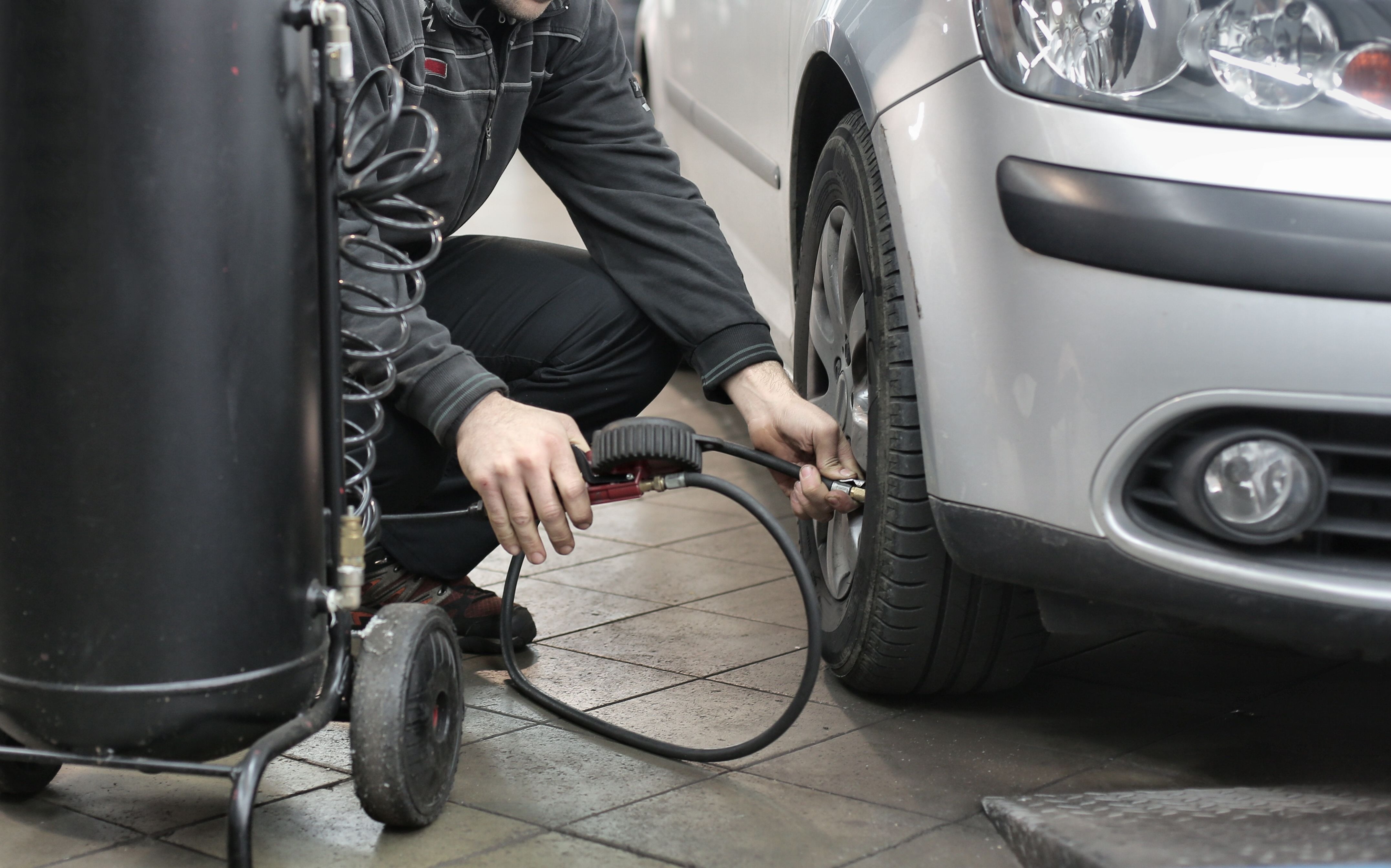
You've probably heard that inflating tires with nitrogen improves performance, reduces wear, and even saves fuel. Some of these claims are myths, but others do have real backing. Here we explain what is true, how the process works, and whether it is really worth it.
The most common myths
There are several popular beliefs about nitrogen that are not fully proven:
- That it offers better vehicle performance.
- That it noticeably reduces tire wear.
- That it completely prevents pressure loss.
- That it significantly helps save fuel.
None of these advantages hold as strongly as is often claimed. However, nitrogen does offer real benefits, though more moderate than popular myth suggests.
Filling tires with nitrogen does offer real improvements
Being a dry gas with larger molecules, nitrogen keeps pressure stable for longer, prevents rim oxidation, and reduces pressure variations caused by temperature changes.
Main advantages
- Stable pressure: since it contains no moisture, pressure varies less with heat or cold.
- Slower leakage: the gas escapes more slowly than regular air, thanks to the size of its molecules.
- Rust-free rims: since there is no moisture inside the tire, the inner part of the rim is protected.
- Uniform wear: helps the tire make even contact with the road and last longer.
- Not flammable: unlike oxygen, which accelerates the spread of fire.
It is worth noting that the air we normally use to inflate tires already contains 78% nitrogen, 21% oxygen, and 1% other gases. When the switch is made at a specialized center, 100% pure nitrogen is not achieved —that is very difficult to accomplish— but a concentration of between 93% and 95% is reached.
The process and the cost
Switching from air to nitrogen takes around 10 to 13 minutes and involves deflating the tires and refilling them with the gas. At some service centers the cost can range from approximately 200 to 500 Mexican pesos, although at certain gas stations it is offered free of charge when a minimum amount of fuel is purchased (for example, 20 liters).
The track test: nitrogen vs. regular air
To verify whether there is a real difference, a comparison was made between a vehicle running nitrogen and a Ford Mustang running regular air, both subjected to several laps on a racetrack.
- The Mustang with regular air started with a cold pressure of approximately 2.76 bar (276 kPa). After several laps, the pressure rose between 0.21 and 0.28 bar across all tires, and on the right side —the one that works hardest in corners— it reached 3.24 bar (324 kPa), meaning an increase of nearly 0.48 bar.
- The nitrogen-inflated tires started at 2.48 bar (248 kPa) and, after the same type of track demands, remained virtually unchanged.
This pressure difference matters because, when a tire heats up and pressure rises, it deforms: the center of the tire is the part that has the most contact with the pavement, which causes uneven wear. With nitrogen, since pressure does not rise as much, wear remains more uniform.
In the days that followed, the nitrogen-filled tire maintained a steady pressure of approximately 2.48 bar (248 kPa) under normal street use, confirming the stability of the gas even outside extreme conditions.
Things to keep in mind
- Does not eliminate inspections: even if you use nitrogen, you should check the pressure with a gauge at least every two weeks, and always when cold (before the car has been driven).
- Extra cost: regular air is usually free at most service stations, while nitrogen has an additional cost at specialized shops.
- Limited availability: not all service centers or gas stations offer this service.
- Can be mixed: if you need more pressure on the road and only regular air is available, you can use it without any problem; it only slightly reduces the nitrogen purity percentage.
Is it worth making the switch?
If you frequently take long road trips, where the tire is subjected to more pronounced temperature changes, nitrogen can indeed represent a noticeable advantage. For normal city use, the switch is not essential: if you have the budget and the opportunity (for example, at a gas station that offers it at no extra cost), it is a good option, but don't expect a drastic reduction in fuel consumption or a radical change in everyday driving.
Are premium second-hand tires worth it?
yes, and we have them at Recoautos at unbeatable prices at this link to find them HERE
In conclusion: nitrogen in tires does offer real improvements in pressure stability, protection against oxidation, and more uniform wear, but it is not an absolute necessity for everyday use. It is an incremental improvement, most useful in demanding conditions such as long trips or track driving.