


Between 1,000 and 2,000 vehicles enter an average scrapyard each year, translating into an average of 3 to 5 recoverable alternators per day. Although around 20% of those parts are discarded due to defects, the rest — nearly 800 alternators annually per facility — retain a useful life cycle that normally ends up in the metal recycling bin. A Final Degree Project from the Polytechnic University of Catalonia (UPC) has posed a simple but little-explored question: can a discarded car alternator become the heart of a small wind turbine?
The starting point: wind energy and the circular economy
The study begins from a context favorable to renewables. Global wind energy reached 837 GW of installed capacity in 2021, avoiding more than 1.2 billion tonnes of CO₂ per year, and in Spain it already represents the leading generation technology, ahead even of nuclear. Against that backdrop, the project proposes giving a second life to alternators from end-of-life vehicles — parts that are usually in good condition after scrapping — by coupling them to a wind capture system to electrify isolated homes or farms, or to pump water from wells and rivers in areas without access to the electricity grid.
A Bosch K1-14V-23/55A alternator was chosen for the study, a 14 V and 55 A model widely used in the automotive industry, from which reliable technical data could be extracted: winding resistance, maximum permissible temperatures and its characteristic curve (relationship between rotational speed and generated current).
From the laboratory to real wind
Using meteorological data from the Tremp weather station (Pallars Jussà, Lleida) — a rural area surrounded by mountains with farms far from the urban center — the wind profile was statistically modeled using the Weibull distribution in MATLAB, adjusting the shape and scale parameters month by month.
The conditions of a reference commercial wind turbine (the Skystream 3.7, with a nominal 2.4 kW) were then replicated in the laboratory, extrapolating its blade geometry to the Bosch alternator via a three-phase electric motor coupled by belt and controlled with a variable frequency drive. The setup made it possible to plot the real current generation curve as a function of speed and compare it with the theoretical data.
The practical conclusions were clear:
- A multiplier of at least 20:1 is needed. The average wind speeds in the area (around 1.5 m/s) are well below the 29 m/s the alternator would require to start without any mechanical reduction.
- Generation is modest but real. With the right multiplier, the alternator can produce an average of around 160 W per day in spring, 212 W in summer, 83 W in autumn and 60 W in winter.
- Viable uses are limited but specific. That output is insufficient to cover the full consumption of a home, but it is enough to power a low-power drainage or irrigation pump (100–140 W), or to partially reduce the electricity bill of an off-grid installation.
- The cost of the multiplier (between €500 and €2,000) is the main economic barrier, since commercial mini wind turbines, ready to install, currently exist for around €3,000 and with far superior efficiency.
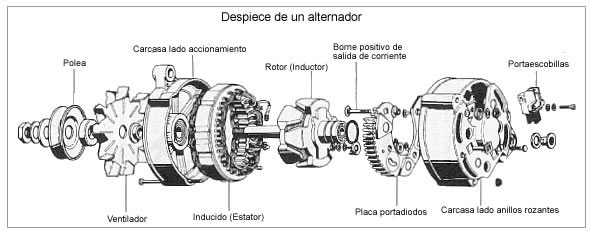
An interesting parallel: when "oversizing" is also efficient
Interestingly, the heavy vehicle alternator industry has for years been advocating a philosophy that connects with this project from the opposite angle: that of oversizing the alternator relative to the actual electrical load. As explained in a technical article by Delco Remy, an alternator operates most efficiently when running at only between 35% and 50% of its rated capacity — for example, choosing an alternator with twice the output the system demands. This translates into three documented benefits in truck and heavy vehicle fleets:
- Lower fuel consumption, thanks to the alternator working at its most efficient point.
- Longer service life for the alternator itself, by reducing the thermal and mechanical stress on bearing grease, rectifier diodes and stator insulation.
- Healthier batteries, because an oversized alternator delivers more energy even at low revs (idle), reducing the depth of discharge of the batteries and extending their life.
Although this is a different context — vehicles in motion versus a handmade wind turbine powered by variable wind — the underlying logic is the same as that revealed by the UPC thesis: the efficiency of an alternator critically depends on the point on its operating curve at which it is made to work. While the university study identifies the opposite problem (the alternator is "oversized" relative to the available wind resource and needs a multiplier to reach its operating window), the heavy transport sector exploits that same principle of operational headroom to gain efficiency, durability and savings.
Conclusion
Reusing scrapyard alternators to generate electricity from wind is technically feasible, as both the theoretical calculations and the bench tests of the project demonstrate. However, it is not a "ready-to-use" solution: these parts were not designed to operate at low speeds or under variable wind conditions, and therefore require mechanical multipliers and adjustments that make the installation more expensive compared to already-optimized commercial wind turbines. Even so, the exercise confirms that there is scope for the circular economy in the energy sector: with adaptations — new brushes, lighter casings, better transmission ratios — these recovered components could come to play a modest but real role in the electricity supply of isolated rural areas, in line with the sustainability and waste reduction objectives that are driving an increasing number of projects of this kind.
Sources: Acevedo Ocampo, S. (2023). "Study of the use of alternators from end-of-life vehicles for energy applications". Final Degree Project, UPC. / Delco Remy (2019). "Tech Tip: Benefits of Oversizing an Alternator".