


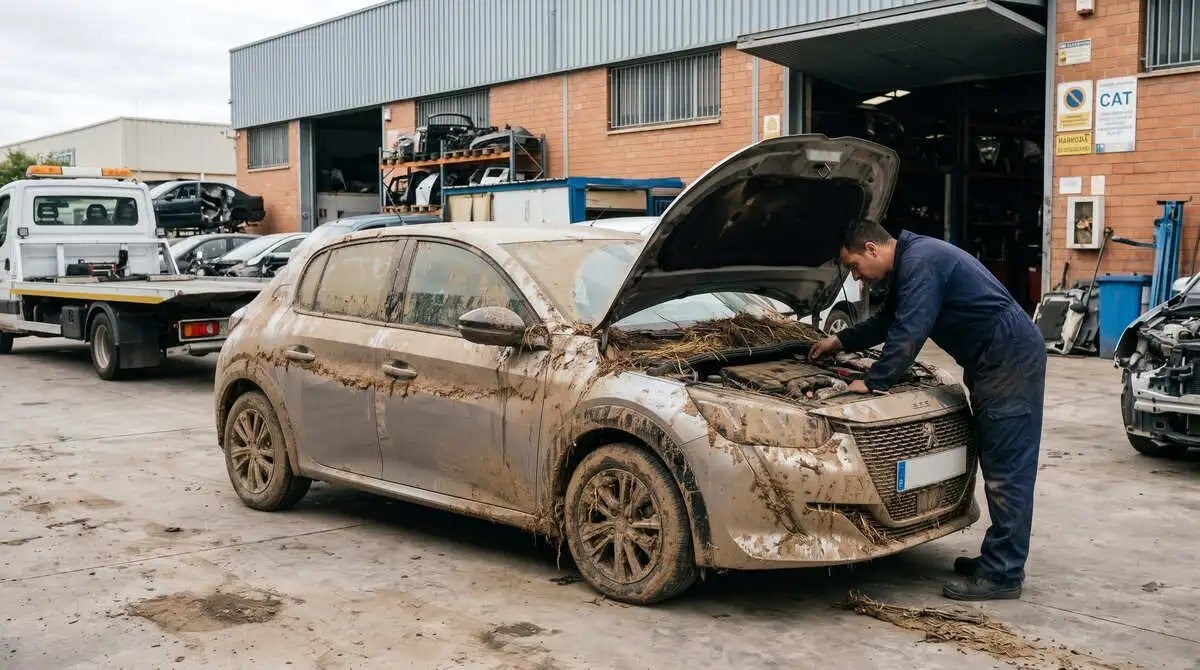
There are now three options for a DANA-affected car: repair it and pass the ITV inspection, sell it with its history properly documented, or permanently deregister it at an authorized treatment center (CAT), the authorized salvage yard that decontaminates it and handles the deregistration. The right option depends on the water damage and the car’s status with the DGT.
At Recoautos, a salvage yard in Hontoria (Segovia), we appraise damaged cars, handle their permanent deregistration and sell used original parts for those who decide to repair them. This guide explains how to check your car’s status, when repairing it makes sense and when deregistration is the better choice. If you’ve already decided, we’ll provide a free appraisal and handle the deregistration.
What’s the current status of your DANA-affected car?
Your DANA-affected car may already be listed as permanently deregistered with the DGT even if you haven’t filed any paperwork. Many vehicles moved to storage lots and assessed by the Consorcio were permanently deregistered automatically on October 30, 2025 (first additional provision of Royal Decree-Law 12/2025).
Before deciding, check these three things:
- Its status in the Vehicle Register. Check it in the miDGT app or request a vehicle report from the DGT. If it’s listed as permanently deregistered, the car has been taken off the road permanently (Article 35 of the General Vehicle Regulations).
- The DANA notation. The DGT marked damaged cars as “affected by the DANA” to prevent them from returning to the road without first passing an ITV inspection and to help prevent sales fraud (DGT press release dated November 15, 2024).
- Your insurance payout. If you never filed a claim with the Consorcio, do it as soon as possible: claims arising from property damage insurance expire after two years (Article 23 of Law 50/1980 on Insurance Contracts). Check your situation with your insurer or the Consorcio itself.
Applications for assistance to replace your car are no longer being accepted. The national program closed on December 31, 2025 (Ministry of Industry and Tourism), and the final application period for the Valencian regional government ended on October 22, 2025 (Valencian Tax Agency).
Which option is best for your DANA-affected car?
The best option for a DANA-affected car depends on two things: the water damage and how the repair cost compares with the car’s value. As a guide, insurance policies typically cap repair payments at the vehicle’s market value, according to the Consorcio de Compensación de Seguros (Consorseguros, No. 23). You can use the same calculation to decide.
| Option | When it makes sense | What you need |
|---|---|---|
| Repair | Water did not reach the engine or electronics, and repairs cost less than the car is worth | Repair shop estimate and a passed ITV inspection before driving |
| Sell | The car has been repaired and is in good condition | Proof that the car passed an ITV inspection after being declared a total loss, if applicable |
| Scrapping and permanent deregistration | Damage to the engine, electronics or interior, or repairs costing more than the car is worth | Take it to an authorized treatment center (CAT) and obtain a certificate of destruction |
Is it worth repairing a flooded car?
Repairing a flood-damaged car is only worth it if the water didn’t damage the engine or the main electronics, as those are the problems that drive up the repair bill the most. A repair shop will typically check the following:
- Engine: if water enters the cylinders, it can cause internal damage.
- Electronics: moisture corrodes connectors, wiring and ECUs, and faults may appear months later.
- Undercarriage, brakes and suspension: mud and moisture accelerate rusting.
- Cabin: upholstery and carpeting can develop mold and unpleasant odors.
If you decide to repair it, a used original part can lower the bill. We have used ECUs, and if the part you need isn’t in stock, we’ll find it for you through Localizautor.
Before buying, check whether you can install an ECU from a salvage yard in your car: it must have the same part number and be cloned using the data from your original unit. Once repairs are complete, the car must pass its ITV inspection before going back on the road, as the DGT notes.
When is it worth scrapping a car affected by the DANA floods?
Scrapping a car affected by the DANA floods makes sense when repairs cost more than the car is worth or when water has damaged the engine, electronics or interior. If you decide to take it off the road, the law requires you to provide proof that it ultimately went to an authorized treatment center (CAT) (Article 5.1 of Royal Decree 265/2021).
Here are the steps:
- Gather the documents: the application for permanent deregistration, your Spanish national ID (DNI), the vehicle registration certificate and the technical inspection card, or a declaration of loss if they’re missing (Annex III of Royal Decree 265/2021).
- Take the car to an authorized treatment center (CAT) or a collection facility affiliated with one.
- The authorized treatment center (CAT) processes the permanent deregistration with the DGT and gives you a certificate of destruction (Article 6.1 of Royal Decree 265/2021).
- Keep that certificate: it proves you handed over the car for decontamination.
If the car no longer has any market value, handing it over costs you nothing, provided it still has its body and powertrain and no parts have been removed (Article 5.1 of the same royal decree).
Don’t hand your car over to anyone who won’t give you a certificate of destruction. In February 2025, Spain’s Civil Guard found 107 vehicles that appeared to have come from the DANA-affected area in warehouses in Dólar (Granada), according to Car and Driver. The investigation began with a car that had been moved without its owner’s knowledge.
At Recoautos, we handle the appraisal and permanent deregistration of your car: we take care of the paperwork and pickup.
What should you check before selling or buying a car affected by the DANA floods?
Before selling or buying a car affected by the DANA floods, you must check its history with the DGT and, if it was declared a total loss due to damage affecting its safety, confirm that it subsequently passed an ITV inspection. Without that, the DGT will not register the change of ownership (Article 32.8 of the General Vehicle Regulations).
If you sell it, be upfront about its history: the DANA notation appears in the Vehicle Register.
If you’re buying a used car, don’t assume this issue won’t affect you. According to Carfax data published by El País Motor on October 28, 2025, around 3,400 affected cars returned to the road, and 40% are outside Valencia province. Watch for these common signs:
- A damp or musty smell inside the car.
- Rust on the undercarriage, seat rails or seat belt anchors.
- Traces of mud in hidden areas, such as under the trunk carpet.
- Intermittent electrical faults.
- A deregistration recorded on October 29, 2024, in Valencia province.
Frequently asked questions about cars affected by the DANA floods
How can you tell if a car was affected by the DANA floods?
You can find out whether a car was affected by the DANA floods by requesting a vehicle report from the DGT using its license plate number. The DGT marked damaged cars as “affected by the DANA” in the Vehicle Register to prevent them from returning to the road without first passing an ITV inspection and to help prevent sales fraud. If the history shows that notation, ask for proof that the car subsequently passed its ITV inspection.
How much does a salvage yard pay for a car affected by the DANA floods?
What a salvage yard pays for a car affected by the DANA floods depends on its age, model and which parts can still be used. After a flood, the electronics and interior are usually hit hardest, so there’s no fixed price: an appraisal will tell you what it’s worth. We explain the other factors in how much a salvage yard pays for a car.
Want to have your DANA-affected car appraised and deregistered?
If your car was affected by the DANA floods, first check its status with the DGT. If water damaged the engine or electronics, permanently deregistering it is usually the safest option. Recoautos makes it easy:
- Free appraisal through our form or via WhatsApp.
- Free pickup: we collect your car wherever it is.
- Paperwork: we handle permanent deregistration with the DGT.
- Fast payment: you get paid when you hand over the car.
If you have questions about your situation, contact us. And if you’re ready to take the next step, request your free appraisal: send us the make, model, year and location of your car, or call us at 921 42 43 53.