


When you drive, do you notice that the car tends to pick up speed? Or that it is hard for you to change gear? Then, you may have a problem with the transmission system.
At the heart of this mechanism is the clutch kit, which is a set of components that performs several functions within your vehicle's system, such as allowing you to change gears, manage engine power, or ensure that the vehicle moves smoothly and in a controlled manner.
If you need to replace this part, you have probably thought about buying a second-hand clutch kit. But what components make up this kit? Is it something you can replace yourself? Can you use ones from a vehicle of a different make? Let's clear up all these doubts throughout this article.
What is a clutch kit?
It is a set of mechanical components that allow the connection and disconnection between the engine and the gearbox.
In a manual vehicle, when the engine is running it is always turning, but the wheels do not have to be (for example if it is in neutral). The clutch acts as a switch to tell the wheels when they should move or stay still.
But why is it called a kit? Because it is made up of a series of components that work together so that everything functions correctly. When one of them fails, the system collapses.
What is the clutch system for?
You may think that the only function of the clutch is to help you change gear, but no, there are many more functions it performs:
- Its main function is to transmit power, that is, to couple the engine's rotation to the transmission, so that the vehicle can move.
- When we press the clutch pedal, the kit temporarily disconnects the engine from the gearbox, which allows us to move the gearbox lever into a different position. This is why, when you try to change gear without having pressed the pedal correctly, you cannot do it.
- Thanks to controlled friction, the car starts to move gradually from a standstill, meaning the kit acts as a protective barrier that absorbs the initial impact so that pulling away is not a sudden jolt.
- It also acts as a torsional damper, that is, it absorbs the vibrations generated by the engine.
- It acts as protection for the engine and gearbox when excessive effort occurs or the wheels suddenly lock up, preventing mechanical overload that could break internal parts.
What does the clutch kit include?
As we said at the beginning of this post, it is not a single part, but rather a series of components that work together to ensure the correct functioning of the vehicle.
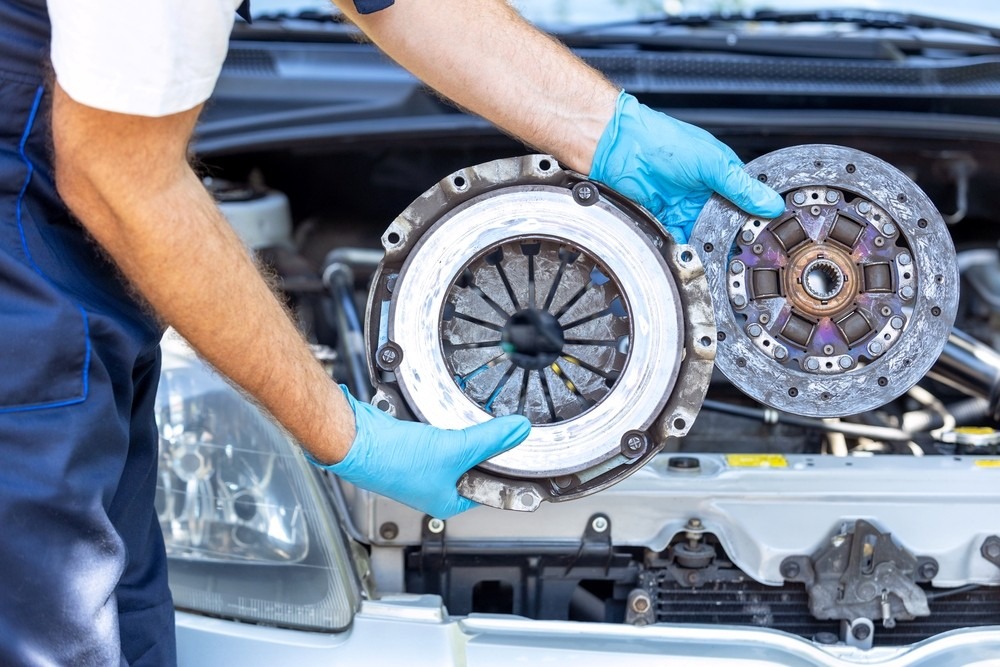
These are the three components of the clutch kit:
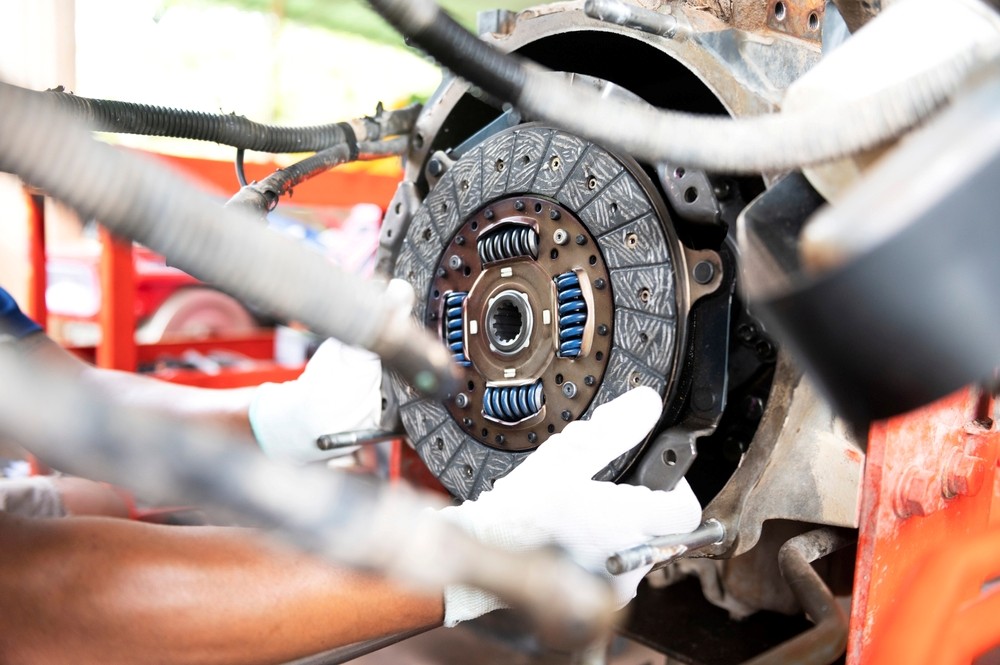
Clutch disc
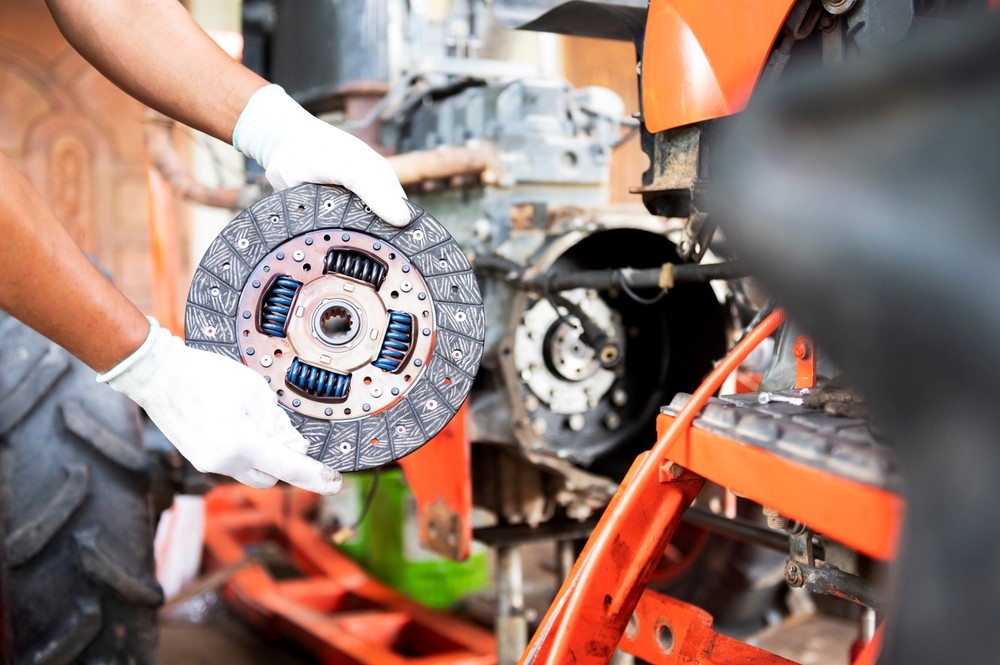
It is a metal disc, coated on both sides with a friction material, and it sits between the flywheel and the pressure plate hub. Its function is to grip the flywheel to transmit the rotation.
If you have ever seen one, you will notice that in the centre it has coil springs, which serve to absorb shocks and vibrations from the engine, allowing for smooth driving.
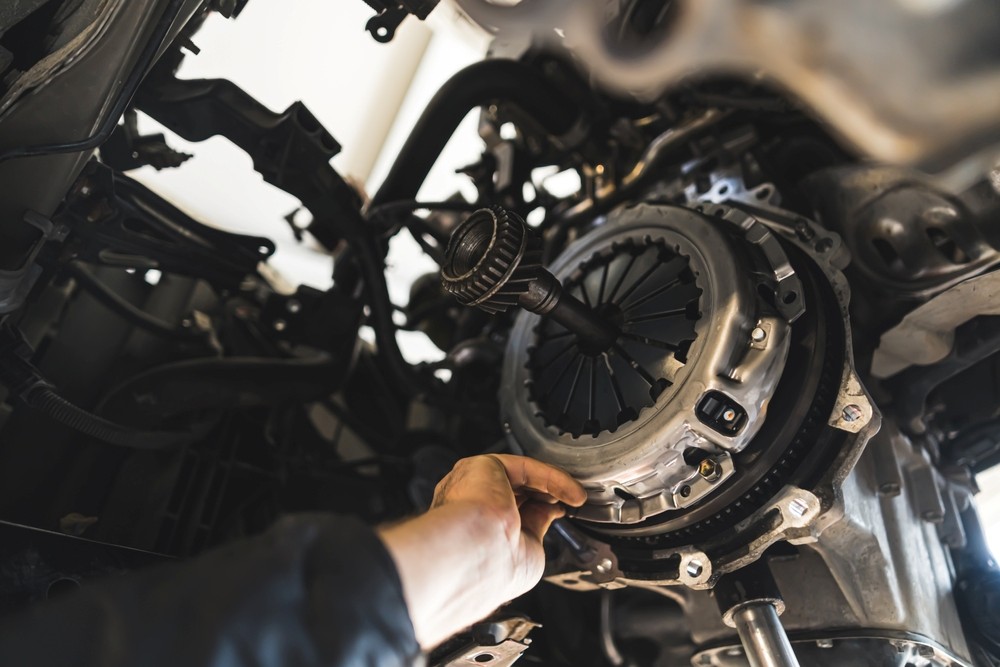
Pressure plate hub
Also known as the pressure plate, it is a bell-shaped steel part that is bolted to the flywheel. Its function is to press the clutch disc against the flywheel, exerting a great deal of force.
How does it work?
- When you press the pedal, the bearing pushes the fingers of the pressure plate hub.
- This causes the part to stop pressing the disc and the power transmission is cut.
Thrust bearing
Also known as the release bearing, it acts as a messenger between the pressure from our foot on the pedal and the main clutch component, pushing the hub towards the centre.
Dual-Mass Flywheel
Yes, we said that this kit consists of three components, but in modern cars there is a fourth, known as the dual-mass flywheel. It is a heavy part on which the clutch rests and is only available in the newest models.
How to tell if the clutch system is failing?
Many symptoms can be associated with other vehicle faults and you might overlook them, but these are usually the most common ones that indicate there is a problem with the clutch system:
The clutch is slipping
This is usually the most common fault, where we press the clutch pedal and notice the engine revs rising, but the speed does not increase (it is common to notice this on hills).
This is because the disc's friction material has worn out and it can no longer grip the flywheel firmly, causing it to slip.
Difficulty changing gears
We mentioned earlier that if you do not press the clutch pedal, you will not be able to change gear, or you will notice that it is difficult, causing the vehicle to "stall".
However, when you do it correctly and notice that it is very hard to change gear or that it grinds, especially with first gear or reverse, it means that the pressure plate is not fully releasing the disc or that there is a problem in the hydraulic system.
The clutch pedal is hard to press
It is normal in new cars for the new pedals to be a little stiff to press, but if you have to apply more force than usual, it means the hub diaphragm is failing.
You hear squealing noises
When you press the clutch pedal, do you hear a metallic sound that is quite high-pitched, similar to a squeal or the sound crickets make?
This means there is a problem with the thrust bearing, which has run out of lubrication or has play.
Burning smell
This smell is easy to recognise, because it is similar to the one produced by the brakes when they are overheated. Although it does not always mean there is a problem, because it is common to notice it when starting on a slope or manoeuvring a lot when parking.
Jerking when pulling away
If when you release the pedal the car does not pull away smoothly, but instead gives small jerks or annoying vibrations, it means the disc may be warped, dirty with oil, or that the shock-absorbing springs have broken.
How often should the clutch kit be replaced?
It is natural to ask yourself this question, but unfortunately there is no answer, because there is no fixed mileage and everything depends on how you use the car.
The average lifespan of a clutch kit
The average lifespan of a clutch kit is roughly between 150,000 and 200,000 kilometres, but this can change depending on where you drive.
For example, in the city, where you have to make uphill starts, constantly change gears at traffic lights…. Its life can be shortened to 100,000 km. If you drive on roads or motorways, where you barely change gears, then its useful life can reach 300,000 km.
Are clutch kits universal?
It is true that in some vehicles parts from other cars can be used, even from other makes. But this is not the case with the clutch kit.
It is not a universal part; each one has been designed for a specific model, with a unique design for that vehicle. That is to say, you could not use a clutch kit from a Volkswagen Golf in an Audi 5. In the same way, diesel clutch kits cannot be used in a petrol engine.
To check compatibility, you need to look up the VIN (Vehicle Identification Number) or the engine code.
How much does it cost to replace the clutch kit?
Again we are faced with a difficult question to answer, because the price will depend on the car model, the condition of the parts….
But to give you an idea, the price for a basic kit can be between 350–750 euros, while a clutch kit with a dual-mass flywheel can go up to 1,400.
Is it a part you can replace yourself?
Not at all, because it is a component that has to be accessed from underneath the car, very specific tools are required, and moreover some parts weighing more than 40 kg have to be moved. If you do not have a workshop at home, you will not be able to do it.
How much is a clutch kit worth?
We come back to the same point — it is hard to say because everything depends on the make or the model. It is clear that if you buy it from the manufacturer, it will be much more expensive, because the part is new and comes from the factory.
So, to save money in this regard and invest it in the labour costs at the workshop, you can buy a second-hand clutch kit whose price can be between 40–60% cheaper than the new part.