


Engine seizure is one of the most serious failures a workshop can encounter: it involves the seizing or fusing of internal metal parts due to overheating and lack of lubrication. Diagnosing it accurately — and distinguishing it from other failures with similar symptoms, such as simple overheating — is key to avoiding the dismantling of an engine that can still be repaired, or to not wasting time trying to repair one that cannot.
What exactly happens when an engine seizes
Inside the engine there are many metal surfaces in constant friction: piston-liner, connecting rod bearings against the crankshaft, valves against their guides. That friction generates heat and wear — something normal and controlled as long as the lubrication and cooling systems are working correctly. When either of the two fails, the parts expand beyond the expected limits and, instead of contracting as they cool, end up seized or even fused together. That seizure is what we colloquially call a seized engine.
Most common causes
- Inadequate lubrication. Insufficient oil pressure or degraded oil that does not reach the gap between piston and liner in adequate quantity. This is the most common cause of seizure.
- Poor cooling. Lack of coolant or failure in the cooling system (thermostat, electric fan, radiator), preventing the heat generated in the upper part of the cylinder from being dissipated.
- Connecting rod imbalance. An unbalanced crankshaft causes excessive friction on the connecting rod and localised heat build-up in that area.
- Compression ring failure. The lubricant film between piston and cylinder breaks down, causing friction and temperature to spike.
The areas most commonly affected are the cylinder liner and the piston, although the valves against their guides, the crankshaft bearings against the connecting rods, and even the gearbox against the differential can also seize.
Symptoms for determining seizure
As this is a failure that manifests while the engine is running, these are the signs to look for during diagnosis:
- Sudden loss of power and speed, with the engine increasingly under strain.
- Characteristic metallic noise, typically described as a ringing similar to bells or a dry knocking coming from the engine block.
- Low oil pressure on the warning light or on the diagnostic pressure gauge.
- Check Engine or temperature warning light on on the instrument panel.
- Overheating with the temperature needle in the high or red zone.
- White or bluish smoke from the exhaust, a sign of oil burning due to overheating.
- Complete engine seizure in the most advanced cases, with no possibility of starting.
Protocol if it occurs while driving
If the vehicle arrives at the workshop after a warning of this type, or if the mechanic detects the symptoms during a road test, it is advisable to follow this order:
- Release the accelerator and ease off the clutch so that the oil continues to lubricate the cylinder while the temperature drops.
- Stop the vehicle as soon as it is safe to do so and switch off the engine.
- Do not restart the engine or force the vehicle to keep moving until the cause has been identified.
- If the cause is reversible — a one-off shortage of water or oil — and there is no metallic noise or compression loss, driving on at low speed may be attempted. If not, the vehicle must be immobilised and taken to the workshop.
Workshop diagnosis
Once on the lift, the typical inspection includes:
- Piston-to-cylinder clearance. Excessive or irregular clearance confirms seizure damage.
- Condition of the crankshaft bearings. Scored, blued by heat or with fused material.
- Oil pressure when cold and when hot, comparing against the manufacturer's reference value.
- Hoses and cooling circuit, looking for leaks that explain the lack of coolant.
- Appearance of the oil on the dipstick: if it looks milky, there is a mix with coolant, which points to a damaged head gasket in addition to the seizure.
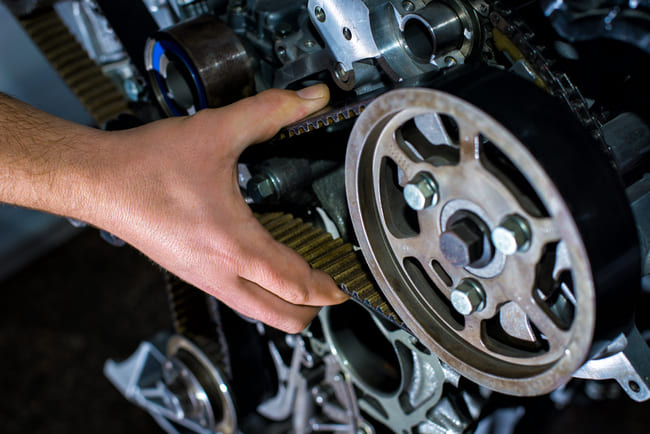
Parts typically replaced after a seizure
The extent of the repair depends on which components have been damaged. These are the most commonly requested parts in these cases, available and verified in the Recoautos catalogue:
- Verified complete engine — when the block, crankshaft or pistons are beyond use, replacing the complete engine is usually more cost-effective than rebuilding the original.
? View second-hand complete engines at Recoautos - Oil pump — if the seizure originated from low oil pressure, the pump must be inspected and, if necessary, replaced before fitting any engine.
? Search for oil pumps at Recoautos - Water pump — a common cause of poor cooling when it loses its seal or stops circulating coolant.
? View water pumps at Recoautos - Cylinder head — always inspect when milky oil or compression loss associated with overheating appears.
? Search for cylinder heads at Recoautos - Timing kit — it is advisable to replace it in the same service if the replacement engine requires it or if the original showed signs of wear.
? Search for timing kits at Recoautos - Oil filter housing — frequently damaged or leaking when there has been prolonged oil pressure loss.
? View oil filter housings at Recoautos
How to prevent seizure
- Check oil and coolant levels before each job and follow the manufacturer's recommended replacement intervals.
- Monitor temperature during road tests and do not ignore the temperature warning light.
- Avoid harsh acceleration with a cold engine, before it reaches its operating temperature.
- Do not ignore vehicle warnings (Check Engine, oil pressure, temperature) or recommend clearing faults without investigating the cause.
Quick reference table for workshop diagnosis
| Symptom | Probable cause | Recommended action |
|---|---|---|
| Metallic noise + power loss | Seizure in progress (piston-liner or connecting rod bearings) | Stop the engine, do not force the vehicle to keep moving |
| Low oil pressure | Oil pump failure or insufficient oil level | Inspect and replace oil pump |
| Overheating + milky oil | Poor cooling + possible head gasket | Inspect cylinder head and cooling system |
| Complete seizure, will not start | Confirmed block seizure | Assess replacement complete engine |
Whenever there is any doubt about the compatibility of a part with the vehicle's exact engine specification, at Recoautos we verify every component before sale and confirm its OEM reference, which reduces the margin of error in diagnosis and fitting.