


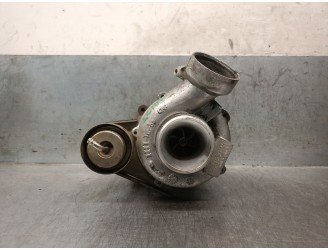
TURBOCOMPRESOR A6640960299 5080373AA
Withdrawn from: CHRYSLER PT CRUISER (PT_) 2.2 CRD
El turbocompresor de un coche, a veces abreviado como turbo, es un componente mecánico esencial en la mayoría de los motores de combustión interna modernos, tanto en los coches de gasolina como diésel. Si esta pieza falla, o está compensando a darte problemas, es el momento de cambiarlo. Y, por desgracia, no es una pieza barata… ¡Salvo que compres un turbocompresor de segunda mano en nuestro desguace! Piezas usadas, ¡en perfecto estado para seguir disfrutando de tu coche por muchos años!
A turbocharger is a forced induction device used in motor vehicles that harnesses the energy from exhaust gases to force more air into the engine's cylinders, allowing more fuel to be burned. This results in greater engine power and efficiency.
This part consists of two turbines connected by a shaft:
That compressed air is then injected into the engine, allowing more fuel to be burned efficiently, delivering greater power and performance while driving. Since its lubrication depends on the engine oil, its condition is directly tied to how well you maintain your vehicle.
There are several symptoms that may indicate a damaged turbo, such as:
There are indeed, and here is why:
So it is important to understand that a turbocharger is designed for a specific engine. You cannot fit a petrol turbo in a diesel car, and the same applies the other way around.
No, because electric cars do not use a combustion engine and therefore produce no exhaust gases. In that context, the equivalent component is known as an electric turbo, which is also used in high-end petrol or hybrid engines to eliminate turbo lag (response delay) by using a small electric motor.
Above all, pay attention to the part reference or code, as it must be compatible with your car's engine. It is important to know that car turbochargers are not universal, so you cannot use one from a different make — and in many cases, not even from the same one. Here is why:
It is a mechanism that allows the angle of the vanes (blades) inside the turbine to be adjusted. By changing the angle, the speed at which exhaust gases strike the turbine is controlled. This enables the turbo to operate efficiently both at low rpm (to eliminate lag) and at high rpm. It is very common in diesel engines.
First and foremost, every part you find in our catalogue has been previously tested and inspected to ensure it works correctly and is in perfect condition. Secondly, there is the savings factor. Replacing a turbocharger is not cheap — it requires professional labour and the part itself is not inexpensive. However, by purchasing a used turbocharger, the money you save can go straight towards your mechanic's labour costs.


