


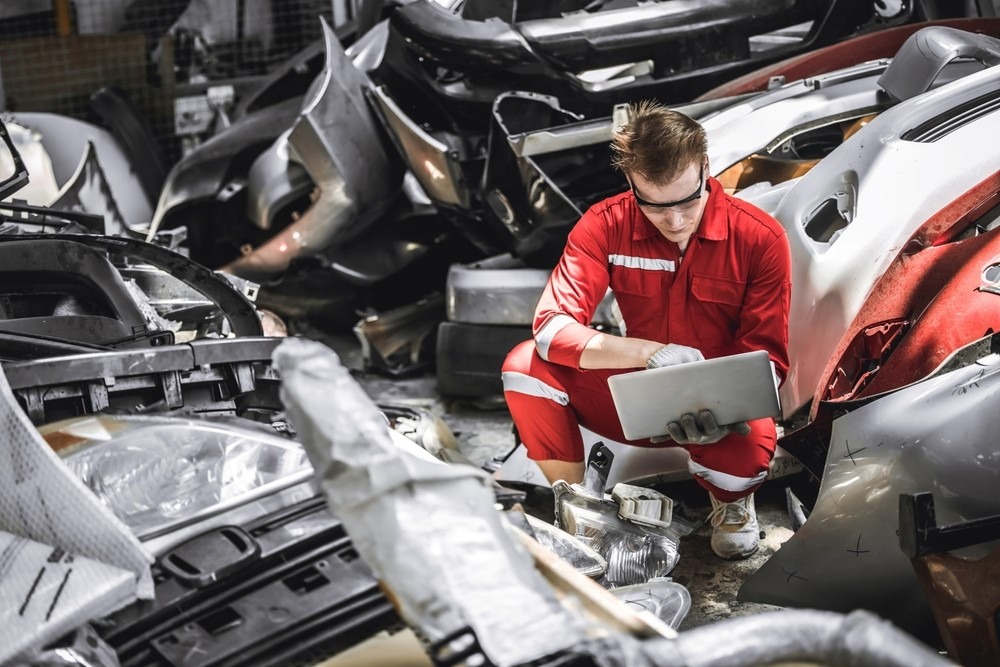
You have surely heard about scrapyards many times. But have you ever wondered what their purpose is? What's more, did you know that they are the perfect place to find spare parts? Such as buying second-hand car engines, tyres, and hundreds of parts to replace the old ones on your vehicle.
Throughout this article we will analyse the basic functions of a scrapyard, as well as how you can take advantage of it to save money when looking for spare parts for your car!
What is a scrapyard?
Scrapyards, also known as CAT (Vehicle Treatment Centres), dismantlers, breakers, or junkyards, are establishments authorised to receive vehicles that have reached the end of their useful life, with the main function of managing these vehicles in a comprehensive and environmentally responsible manner.
What are the functions of a scrapyard?
Exactly, what is a scrapyard for? Is it only for dealing with old cars? The truth is, they do much more than that.
Allow us to explain all of its functions:

Receiving and deregistering vehicles
Scrapyards receive vehicles that their owners wish to permanently deregister from circulation. They are the ones who handle the necessary paperwork with the Directorate General of Traffic (DGT) to certify the deregistration of the vehicle.
Decontamination of vehicles
Once the vehicle has been deregistered, they proceed to remove all waste that may be hazardous or polluting, such as oils, brake fluids, batteries, tyres, and other components that require special treatment. In this way, they prevent environmental damage.
Dismantling and classification of parts
The next step is to carefully disassemble the parts of each vehicle that are still in good condition and can be used for compatible vehicles. These parts are stored for subsequent sale as second-hand spare parts.
Recycling of parts
Parts or sections of the vehicle that cannot be reused, such as ferrous metals, plastics, glass… are sent to recycling plants for processing and reincorporation into the production chain as secondary raw materials.
Purchase of vehicles
It is not uncommon for a scrapyard to offer this service, especially for vehicles that are at the end of their life or from which parts can be salvaged for later sale as spare parts.
How much does a scrapyard pay for a car? Well, the price varies according to several factors:
- The condition of the vehicle, as if it is in good condition, you will be able to extract parts.
- The make and model of the car.
- The age of the car. Generally, newer cars have more value, although older cars, such as classics or collector's vehicles, may have added value due to the rarity of their parts.
- The weight of the vehicle to be scrapped.
- The value and rarity of the parts.
Sale of vehicles at scrapyards
Is it possible to buy a car at a scrapyard? The short answer is yes. However, in recent years, this sale has been limited to three types of vehicles:
- Vehicles classified as recoverable, meaning those with minor damage or that can be restored with a few repairs.
- Vehicles that have belonged to fleets and companies. When a company renews its fleet, it is not uncommon for them to sell the old cars to a scrapyard. These, if they wish, can put them up for sale if they are still roadworthy.
- Vintage or collector's vehicles, for enthusiasts of classic car restoration.
Why buy parts at a scrapyard?
As we mentioned at the beginning of this post, it is possible to acquire spare parts for vehicles at a scrapyard, but why do so? Why not buy new parts?

Cost savings
The first and most basic reason of all is: the savings involved in buying spare parts.
What the manufacturer offers are new parts, so they will be much more expensive. At a scrapyard, on the other hand, you can acquire them for a lower price. You may even find one that is compatible with your vehicle model.
Extensive catalogue
While the manufacturer's catalogue may be more limited, or they may not have the part you need, scrapyards have a catalogue with hundreds of parts.
Basically, they put all parts of the car up for sale; you can buy the car seats, the gear lever, the tyres, the spark plugs, the ventilation grille… Everything!
Furthermore, as they receive cars almost daily, they continuously update their catalogue. If they do not have the part today, they may get it soon.
Inspected parts
You might think that being second, third, or even fourth-hand, these parts will be in very poor condition. Nothing could be further from the truth.
Scrapyards have professionals who analyse, one by one, the parts they extract from vehicles, to determine whether they can continue to be used. To do so, they test them in vehicles and systems they have in the workshop. Those that are not suitable are discarded and sent for recycling.
Possibility of finding parts for older cars
As the years go by, it becomes increasingly difficult to find parts for certain car models, especially older ones.
By going to a scrapyard, there will always be a chance that they have the part you need. And if not, they may be able to help you find it.
Professional advice
The scrapyard staff will help you find the spare parts you need for your vehicle. They can also advise you on possible spare parts that are compatible with your vehicle's make and model.
Some tips for getting the best second-hand parts for your car
Allow us to give you some tips that will come in very handy when you embark on the search for used spare parts for your car:

- Only go to approved scrapyards with years of experience.
- Never be afraid to ask. The scrapyard staff have years of experience and will be able to help you easily find the part you need.
- Do not despair if you cannot find the part you were looking for at that moment — they are sure to receive it soon!
- Check the scrapyard's warranty policies, to make sure they will cover any issue that may arise with the spare part you have purchased.
- Leave the installation of the part in the hands of a professional, especially those that are more delicate.
- When you buy a part, always inspect it upon receipt, to make sure it is in perfect condition.