



Have you turned on your car's air conditioning expecting a burst of cool, refreshing air but only warm or hot air comes out?
This means that your car's air conditioning system is failing. What could be the cause? It may be due to many factors, from something as simple as a gas recharge to parts of the system not working correctly.
Throughout this article we will analyse the most common reasons why a car's air conditioning does not cool, providing solutions for each of them, from purchasing a new second-hand air conditioning system to a thorough cleaning of the system.
What is a car's air conditioning?
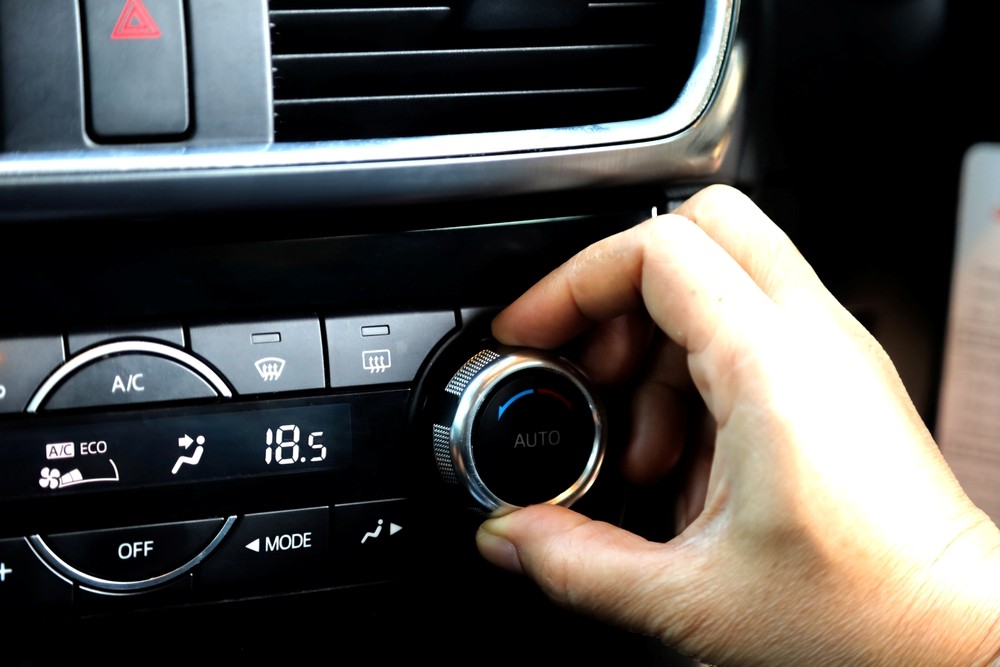
It is an advanced thermal control system, known as climatronic, which uses an Electronic Control Unit (ECU) and a network of sensors to maintain the temperature inside the vehicle according to the user's preferences.
That is to say, it is a unit made up of several components that, working together, allow the temperature inside the vehicle to be adapted to the driver's preference.

How does a car's air conditioning work?
Its operation is based on what is known as the refrigeration cycle:
1 – The compressor, which is driven by the engine, pressurises the refrigerant gas.
2 - The hot gas is cooled in the condenser, which is the front radiator.
3 - The cooled liquid passes through the expansion valve.
4 – The cold refrigerant absorbs the heat from the cabin air in the evaporator, cooling the air before it is distributed.
If when you turn on the air conditioning it does not cool, then it means there is something in the circuit that is failing.
Is it necessary to recharge the car's air conditioning?
This is a question many drivers ask themselves, but it is due to their lack of knowledge. Far from what many people believe, the air conditioning circuit is a closed system that contains refrigerant gas, which is not consumed through use.
It only needs to be recharged when there has been a gas loss caused by a leak in the system or in the event that we receive a warning from the compressor.
Why is the air conditioning not cooling? The most common causes!
Now let's look one by one at the different reasons why your car's air conditioning may not be cooling. Take note of the options to fix it!
There is a leak or the refrigerant gas is at low pressure
The most common cause, and the easiest to detect, is a gradual loss of refrigerant gas.
To help you understand, the air conditioning circuit is made up of a series of pipes, hoses and seals, which are constantly subjected to vibrations and large changes in pressure and temperature. Over time, it is normal for leaks to occur at the weakest points, such as:
- The rubber seals that are attached to the circuit can dry out and lose their airtightness.
- The condenser is located at the front of the vehicle, making it a part vulnerable to stone or gravel impacts.
- The hoses are flexible and connected to the compressor, but over time they can crack due to friction with other engine components.
So, the whole process begins with the search for leaks, for which a fluorescent dye is used in the circuit, along with a gas recharge, to check where the leak may be. This will have to be done at the workshop.
Compressor failure
In case you did not know, the compressor is the heart of the air conditioning system, and is responsible for pressurising the refrigerant gas and initiating the cooling cycle. If it does not activate, the air conditioning will not expel cold air.
However, this can be due to two reasons:
Clutch failure
Traditional compressors use an electromagnetic clutch, which couples the compressor to the engine when the A/C button is pressed. If this fails, due to a blown fuse or a faulty relay, the compressor does not spin, even if the engine is working correctly.
It is an easy fault to detect, because you do not hear the click or the increase in engine load when the air conditioning is switched on.
Internal compressor failure
Modern compressors, that is, variable displacement ones, can suffer internal damage, such as worn valves or pistons.
For this reason, the compressor may spin but does not generate sufficient pressure for the state change to occur and cool the air. You will notice because the air will not be cold enough and you will hear metallic noises or squealing coming from the engine area when you turn on the air conditioning.
In this case, you may need to buy a compressor to replace the part or change the pistons and valves.
Blockage caused by dirt in the evaporator or condenser
The entire refrigeration cycle requires the circuit to be clean and free of obstructions in order to work.
In this case, we may first encounter a blocked condenser, which is located at the front of the vehicle. If the fins are covered in dirt, leaves or mud, it will not be able to dissipate the heat of the gas to the outside.
The other cause is that the evaporator, located inside the dashboard, may have accumulated dirt or dust on its fins. You will notice because when you turn on the air you will detect an unpleasant damp smell.
Clogged pollen filter
The fourth cause may be due to the pollen filter, which is responsible for retaining particles such as dust and pollen before the air enters the cabin. Over time, it is normal for it to become saturated with dirt, preventing air from passing through it.
You will notice it because when you turn on the ventilation very little air passes through the vents. The solution is simple: replace it or clean it thoroughly.
Electronic system failure
Modern air conditioning systems use a series of "helpers" that allow them to regulate the vehicle's temperature according to the instructions from the control panel.
If any of these fail, such as the temperature sensor, it may believe that the interior temperature is incorrect and adjust it, making it colder or warmer until it determines it is correct.
This is the most costly failure, as the mechanic will have to check all the electronic components and replace them with new ones.
How much does it cost to fix a car's air conditioning?
It is difficult to give an exact figure, as the cost of the repair can vary depending on the type of problem, but let us consider several scenarios:

Low cost
The lowest repair cost can range between 40–150 euros, and would correspond to maintenance tasks such as gas recharge, replacing the pollen filter or a fuse.
Medium cost
Here we are talking about repairing a leak, replacing a relay or sensor, or repairing the system's dampers, the cost of which can range between 150–400 euros, depending on the repair.
High cost
A price between 400–1,200 euros, as you would need to replace the compressor or the condenser. However, the cost can be reduced if you buy, for example, a second-hand compressor from a scrapyard, saving between 40–50%.
Complex fault
If we are dealing with a complex fault, the cost of the repair would exceed 1,200 euros, as we are talking about a fault in the evaporator or the internal actuator of the system.