



The heat is already here, and turning on the car's air conditioning becomes an indispensable relief, especially on long journeys during the holidays.
However, what happens when you activate the car's climate control and it only blows hot air or barely cools? It is a fairly common situation, and just as frustrating, that will ruin the comfort of your journey.
Before you get stuck with this problem, it is important to understand the reasons behind a poorly performing air conditioning system — discovering the most common causes why your car is not cooling and what you can do about it!
How does a car's climate control system work?
Your car's climate control system, especially the air conditioning, works thanks to a closed refrigeration cycle that manipulates the refrigerant gas (also known as the refrigerant agent) to absorb heat from inside the cabin and expel it to the outside.
It is a process similar to that of a refrigerator, based on the physics of gases that change state and temperature when pressure varies.

The key components in the process
First, you should familiarise yourself with the components that form part of this process:
- The compressor, which is a pump driven by the engine, responsible for compressing the refrigerant gas.
- The condenser, which is similar to a radiator, receiving the refrigerant gas at high pressure and temperature.
- The desiccant filter, also known as the accumulator, which filters impurities, absorbs refrigerant moisture and protects the system.
- The expansion valve, which reduces the pressure of the liquid refrigerant.
- The evaporator, which acts as a heat exchanger.
- Refrigerant gas, which is the fluid that circulates through the system changing state.
- The cabin fan, which drives air through the evaporator and distributes it through the car's vents.
- The cabin filter, which filters outside air before it enters the system and the cabin, removing dust, pollen and other particles.
What is the refrigeration cycle followed by the air conditioning?
Now that we know each component of your car's climate control system, let's move on to the steps followed to activate the air conditioning:
1. Compression
The compressor draws in the refrigerant gas at low pressure and low temperature, compresses it and raises its pressure and temperature, converting it into hot gas at high pressure.
2. Condensation
The hot gas is sent to the condenser, transferring the heat from the refrigerant to the outside air. As it cools, the gas condenses and becomes a liquid at high pressure and ambient temperature.
3. Filtration and dehydration
The liquid refrigerant passes through the desiccant filter, which removes any impurities or traces of moisture.
4. Expansion
The high-pressure liquid refrigerant reaches the expansion valve, where it is atomised. This causes a drop in pressure, causing the liquid to cool down and turn into a mixture of liquid and gas at very low pressure and temperature.
5. Evaporation
Its next destination is the evaporator, where the fan passes the warm air from the interior through the cold fins of the evaporator.
During this process the refrigerant absorbs heat from the air, causing the liquid to evaporate and turn back into a cold, low-pressure gas. Meanwhile, the cabin air, having transferred its heat to the evaporator, cools down and is expelled through the car's vents.
6. Return to the compressor
The refrigerant gas, at low pressure and temperature, returns to the compressor to start the cycle again.
Why is the car's air conditioning not cooling?
The reasons why a car's air conditioning does not cool can be very varied, so let's look at everything from minor, easy-to-fix problems to more complex faults:

Low refrigerant gas level
This is usually the most frequent cause. As we have already mentioned, the car's air conditioning system is a closed circuit.
If during that process it loses gas through leaks, or the coolant level is low, it cannot carry out the heat exchange efficiently. The symptoms are usually that the air comes out lukewarm or stops cooling after a while.
Compressor failure
The compressor is the heart of your car's air conditioning system, and if it doesn't work, it cannot compress the refrigerant gas.
When you activate the air conditioning, not only will cold air fail to come out, but you will also start to hear strange noises, as the compressor clutch does not engage.
Blocked or damaged condenser
When this part is dirty, due to the build-up of dust, insects or leaves, or is damaged, it cannot release heat efficiently, reducing the cooling capacity.
Blocked filters
It is true that filters serve the function of preventing small external particles, such as dust, pollen, etc. from entering the cabin.
However, it needs to be cleaned from time to time. If it is very dirty, it restricts the airflow reaching the evaporator and, consequently, the ventilation outlets.
Expansion valve failure
When this part is stuck, blocked or not working correctly, the refrigerant flow will be inadequate, which will prevent the air from cooling.
We will notice this because the cooling will be inadequate and ice will form on the evaporator.
Problems with electrical components
In addition to all the parts mentioned in the previous point, the air conditioning has many electrical components, such as fuses, relays, wiring and sensors.
If any of these parts fails, breaks down or is damaged, it will prevent the flow from working correctly.
Problems with the condenser fan
Another reason why the car's air conditioning may not be working could be that the condenser fan is not functioning.
This part is responsible for dissipating heat so that the coolant cools down, especially when the car is stationary or at low speeds.
Blend door actuator failure
This part, also known by its English name Blend Door Actuator, is a component that controls a flap that mixes the cold air from the evaporator with the warm air from the heating system.
When this part fails, it only lets hot air through or a lukewarm mixture, causing only hot air to come out.
What to do when the car's air conditioning is not cooling?
Let's look at what you can do when you find yourself in the unfortunate situation of your car's air conditioning not cooling:
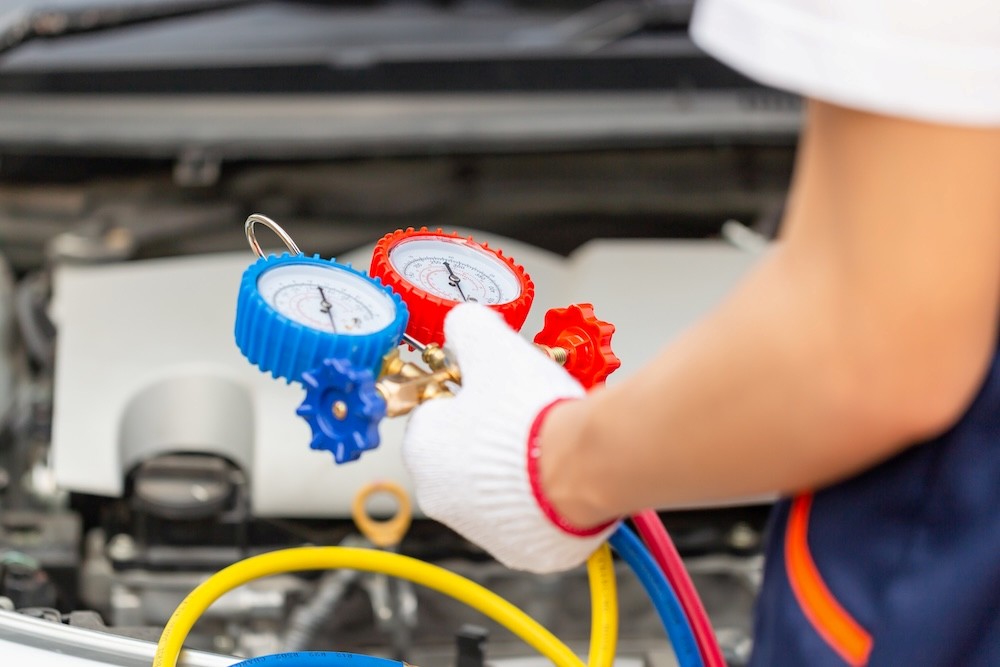
Checks you can carry out yourself
- Check that the air conditioning button is turned on.
- Check the temperature setting to make sure it is set to the minimum.
- Check the airflow, as it may be enough to simply clean the air conditioning grille.
- How can you tell if the car's air conditioning compressor is damaged? With the engine running and the air conditioning on, get out of the car and listen near the engine. When the compressor clutch engages, you will hear a "click" and a slight change in the engine sound. If you don't hear it, it means the compressor is not receiving power.
When should you take your car to the mechanic to have the climate control system checked?
If, despite having cleaned the air conditioning grille and changed the refrigerant, it still does not work, you will need to take the car to the mechanic, as some parts may be failing or the system may not be converting the refrigerant correctly.
It will tell you if there is anything not working correctly, and will take care of cleaning the entire system so that it works properly.